CB-03 · Print workflow · Dec 2025–Mar 2026 · contract closed Jun 2026
A character case that finally fits
Separating expressive details from the geometry that controls physical fit.
- Role
- CAD refinement, fit correction and multicolour file preparation
- Tools
- Rhino, Bambu Studio, STEP / 3MF
- Period
- Dec 2025–Mar 2026 · contract closed Jun 2026
- Status
- First design validated
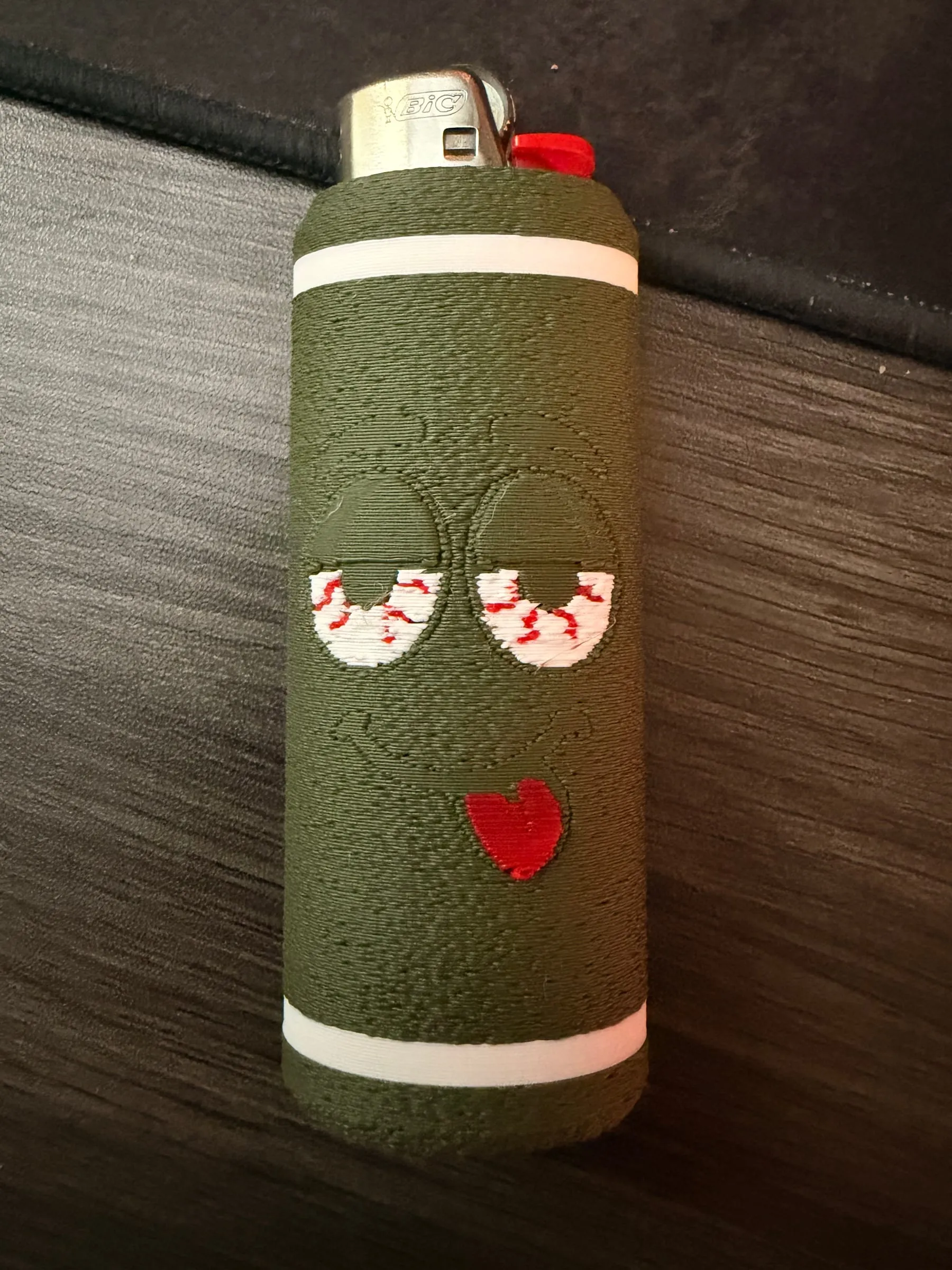
I developed a character-themed lighter case through repeated colour and fit checks, then replaced an unsuccessful uniform offset with dimensions taken from a client-tested reference.
The brief
The client needed individually selectable colour regions, a mix of flush and raised facial features, and a cavity that accepted the lighter. A reference model existed, but its interior and part structure did not reliably meet those requirements.
How it went
Define visual and functional regions
I clarified which facial details should be flush and which should project from the body, refined the lettering and separated the model into colour-selectable parts.
Treat a failed fit as new evidence
Early prints did not fit the lighter. I supplied small cavity samples with different offsets, but a 0.4 mm sample was still too narrow in one direction and too long in another. That showed that uniform scaling or offsetting was insufficient.
Use a physically checked reference
I asked the client to print a small section from a reference sleeve. After they confirmed its fit, I used that interior as a dimensional reference and revised the case around it. The client then confirmed that the new fit worked.
Refine detail visibility
We continued checking the eyes, tongue, seam and fuzzy exterior in Bambu Studio. I supplied an optimised file and later delivered another character variation, reusing the corrected interior.
The decision I would defend
The turning point was replacing a generic clearance adjustment with an interior profile that had been physically checked by the client.
Outcome
The client confirmed the fit on 7 January and reported on 9 January that the lighter fit and the tongue and eyes printed well. They expressed satisfaction and funded the next design. A later variation was delivered; its final physical acceptance is not explicit in the retrieved record.
Delivered
- Colour-separated STEP models
- Small fit-check samples
- Optimised 3MF file for the first character
- OBJ export and a later character variation
Scope and limits
The strongest outcome belongs to the first design. A third-party reference helped establish fit; I do not claim original authorship of that reference.
Posted as “Custom 3D Model Design for character set” · Evidence of root-cause diagnosis · fit iteration · reusable geometry