CB-01 · Product systems · Nov 2025 · prototype feedback Dec 2025
Making deep shelves work harder
A modular shoe organiser shaped by clearance, visibility and real print feedback.
- Role
- CAD modelling, component layout and prototype iteration
- Tools
- Rhino, STEP / STL
- Period
- Nov 2025 · prototype feedback Dec 2025
- Status
- Delivered prototype
I translated a storage concept into a three-part modular system, testing the trade-off between support angle, shoe clearance and the footprint available inside a cabinet.
The brief
The client wanted shoes stored upright and visible inside deep shelving. The brief called for a base tile, angled support and front rail, designed around PLA printing on a Bambu X1-C. A useful model had to accommodate different shoe profiles while remaining slim and adjustable.
How it went
Turn the concept into measurable constraints
I worked from sketches and visual references, then measured three sneaker types to check the proposed spacing. I developed the base, supports and front rail as separate parts and shared intermediate views before final edge treatment.
Compare alternatives before rebuilding
When taller shoes conflicted with the layout, I tested changing the support angle from 75° to 60°. My CAD comparison showed a 33 mm structural offset for only about 7 mm of useful clearance. I recommended increasing the short side of the base to 9 inches instead; the client agreed.
Refine the assembly
I widened the front rail after checking shoe placement, reduced unnecessary bulk, and incorporated edge pegs and sockets so adjacent tiles could connect. I delivered component files and a consolidated STEP model.
Listen to the physical prototype
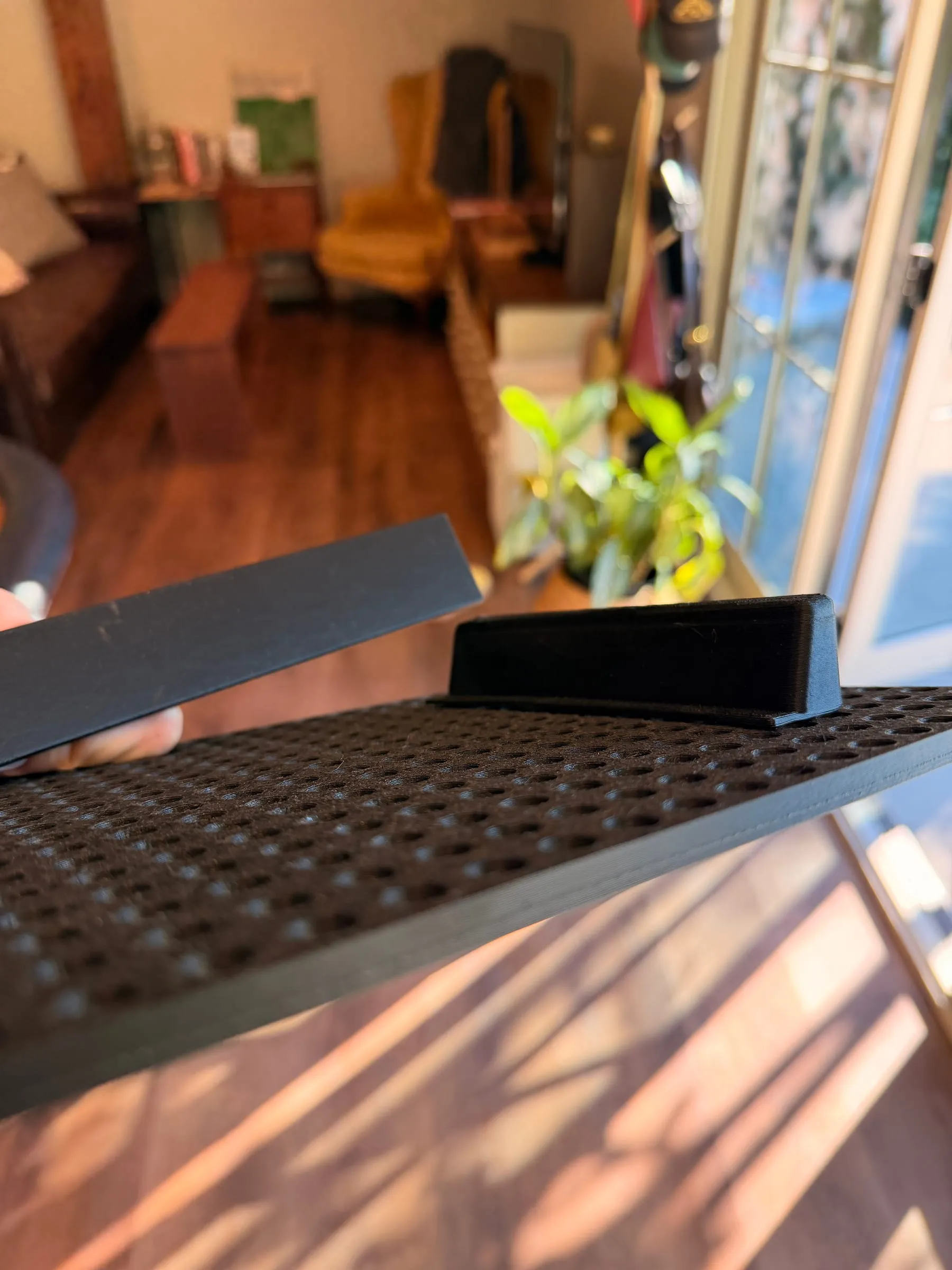
The client later reported that the concept worked, but the support pegs were too tight to remove comfortably. I proposed smaller fit-test samples rather than another complete print. That work became a separate follow-on contract.
The decision I would defend
The important decision was to change the footprint after comparing actual clearance gains, rather than assume that a steeper or shallower support would solve the problem.
Outcome
The client approved the first delivery, left a public 5/5 review and later shared physical prototype photographs. The prototype validated the overall concept while revealing a real-world fit issue to refine.
Delivered
- Base tile, support panel and front rail component packages
- Modular and unmodified base variants
- Consolidated STEP model
- Progress views and prototype revision recommendations
Scope and limits
This case documents the first prototype. A removable production fit and commercial sales are not established by the record. Later tolerance samples belong to the separate second phase.
Posted as “3D CAD Design – Modular Shoe Organizer (Print-Ready STL for Bambu X1-C)” · Evidence of spatial reasoning · comparison of alternatives · modular assembly